- Welcome to YOCH Bearing!
- 0086-531-85866205
- 0086-16653196205
- market@yochibearing.com

Angular Contact Ball Bearing High-Speed Spindle Pairing Methods

How Self-Aligning Roller Bearings Solve Equipment Misalignment Faults
29/06/2026
Lubrication Maintenance Full Process for Spherical Plain Bearing Oscillating Equipment
08/07/20261. Understanding Angular Contact Ball Bearing Fundamentals
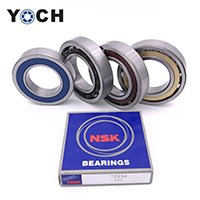
Angular contact ball bearings are engineered to handle combined radial and axial loads simultaneously, making them the preferred choice for high-speed spindle applications. These bearings feature a contact angle between the ball raceway and the bearing axis, typically ranging from 15° to 40°. The contact angle directly influences the bearing’s capacity to support axial forces—larger angles provide greater thrust load capacity. In precision machining centers and CNC equipment, selecting the appropriate angular contact ball bearing configuration is critical for achieving optimal rotational accuracy, thermal stability, and extended service life under demanding operating conditions.
2. Bearing Arrangement Configurations for Spindle Systems
The pairing arrangement of angular contact ball bearings significantly impacts spindle performance and rigidity. Three primary configurations dominate industrial applications:
Back-to-Back (DB) Arrangement: This configuration places the bearing load lines diverging outward, creating a wide support base that enhances moment stiffness and resistance to tilting forces. DB arrangements excel in applications requiring high rigidity against overturning moments, such as heavy-duty milling spindles.
Face-to-Face (DF) Arrangement: With converging load lines, this setup offers excellent alignment compensation capabilities. DF configurations tolerate minor shaft or housing misalignments better than other arrangements, making them suitable for applications where perfect alignment cannot be guaranteed during assembly.
Tandem (DT) Arrangement: This parallel configuration maximizes axial load capacity in a single direction by distributing forces across multiple bearings. DT arrangements are ideal for unidirectional thrust applications such as drilling spindles and grinding wheel heads.
3. Bearing Preload Selection and Implementation
Proper preload application is essential for eliminating internal clearance and enhancing spindle rigidity in angular contact ball bearing pairs. Preload methods fall into two categories:
Fixed Position Preload: Achieved through precise control of inner and outer ring axial positions using spacers or ground shoulders. This method maintains consistent preload regardless of operating temperature but requires meticulous dimensional control during assembly.
Constant Pressure Preload: Implemented via springs or hydraulic mechanisms that automatically adjust for thermal expansion. This approach is preferable for high-speed applications where thermal gradients cause significant dimensional changes, preventing excessive preload buildup that could lead to premature bearing failure.
The optimal preload magnitude balances rigidity requirements against heat generation—excessive preload increases friction and temperature, while insufficient preload compromises accuracy and promotes vibration.
4. Bearing Material and Cage Design Considerations
Modern high-speed spindle bearings utilize advanced materials to withstand extreme operating conditions:
Ceramic Hybrid Bearings: Silicon nitride ceramic balls combined with steel rings offer 40-60% lower density than all-steel bearings, reducing centrifugal forces and enabling 20-30% higher speed capabilities. Ceramic balls also exhibit superior hardness and thermal stability, minimizing wear at elevated temperatures.
Cage Materials: Phenolic resin cages reinforced with cotton or glass fiber provide excellent self-lubricating properties and low friction coefficients. For ultra-high-speed applications exceeding 30,000 RPM, polyether ether ketone (PEEK) or bronze cages offer enhanced durability and oil retention characteristics.
5. Bearing Lubrication Strategies for High-Speed Operation
Effective lubrication is paramount for angular contact ball bearing longevity in high-speed spindles:
Oil-Air Lubrication: Delivers precisely metered oil droplets carried by compressed air directly to the bearing contact zone. This method minimizes oil churning losses while ensuring adequate film thickness, supporting speeds up to 50,000 RPM in precision grinding applications.
Grease Lubrication: Simpler and more cost-effective for moderate speeds (below 15,000 RPM). High-performance greases containing synthetic base oils and specialized thickeners provide extended relubrication intervals. Proper grease quantity is critical—overfilling causes excessive heat generation, while underfilling leads to metal-to-metal contact and rapid wear.
Oil Mist Lubrication: An older technology gradually being replaced by oil-air systems, though still prevalent in legacy equipment. Requires careful environmental management to prevent oil vapor contamination.
6. Bearing Installation and Alignment Procedures
Precision installation directly determines angular contact ball bearing performance:
Temperature Differential Method: Heat the bearing inner ring to 80-100°C using induction heaters or oil baths for interference fit mounting. This thermal expansion allows slip-fit assembly without mechanical force that could damage raceways.
Hydraulic Mounting: For large bearings, hydraulic pressure applied through oil channels in the shaft expands the inner ring radially, facilitating controlled installation with minimal risk of brinelling or surface damage.
Runout Verification: After installation, verify total indicator runout (TIR) using dial indicators. Acceptable runout values typically range from 2-5 micrometers for precision spindles, depending on application requirements.
7. Bearing Monitoring and Maintenance Protocols
Proactive maintenance extends bearing service life and prevents catastrophic spindle failures:
Vibration Analysis: Implement periodic vibration monitoring using accelerometers to detect early signs of bearing degradation. Characteristic frequency analysis identifies specific defect types—inner race, outer race, ball, or cage faults—enabling targeted interventions.
Temperature Monitoring: Install thermocouples or infrared sensors to track bearing operating temperatures. Sudden temperature spikes often indicate lubrication breakdown, contamination ingress, or impending catastrophic failure.
Spindle Runout Checks: Conduct regular precision measurements of tool point runout to detect bearing wear before tolerance violations occur. Annual comprehensive inspections should include disassembly, cleaning, and detailed raceway examination.
8. Common Bearing Failure Modes and Prevention
Understanding failure mechanisms enables preventive measures:
Fatigue Spalling: Caused by cyclic stress exceeding material endurance limits. Prevent through proper preload control, adequate lubrication film thickness, and avoiding overload conditions.
Smearing/Skidding: Occurs when rolling elements slide rather than roll, typically during rapid acceleration or insufficient preload. Implement gradual startup sequences and verify preload settings.
Contamination Damage: Abrasive particles introduced during installation or through inadequate sealing destroy precision surfaces. Maintain clean assembly environments and utilize labyrinth or contact seals appropriate for the operating environment.
By mastering these angular contact ball bearing pairing methods and maintenance practices, manufacturers can maximize spindle performance, achieve superior machining accuracy, and significantly reduce unplanned downtime in high-speed precision applications.
We are a bearing supplier from China. If you want to learn more about other bearing knowledge, you can watch our YouTube or contact us.