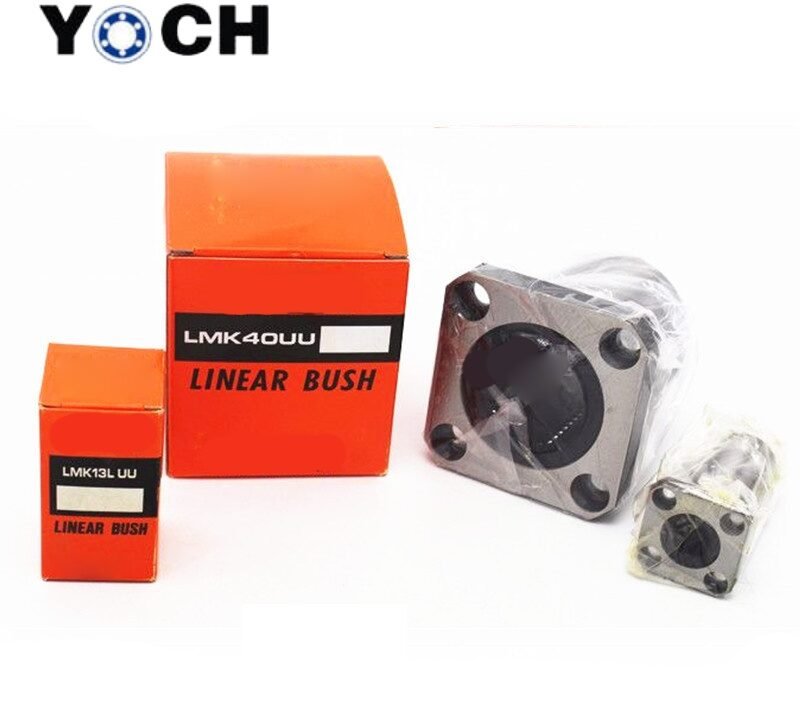
Linear bearing is a low-cost linear motion system used with the cylindrical shaft for unlimited travel. The working load of such bearings is small due to the point contact of the ball and the shaft. The balls can rotate with minimal frictional resistance, thus obtaining high-precision smooth movement.
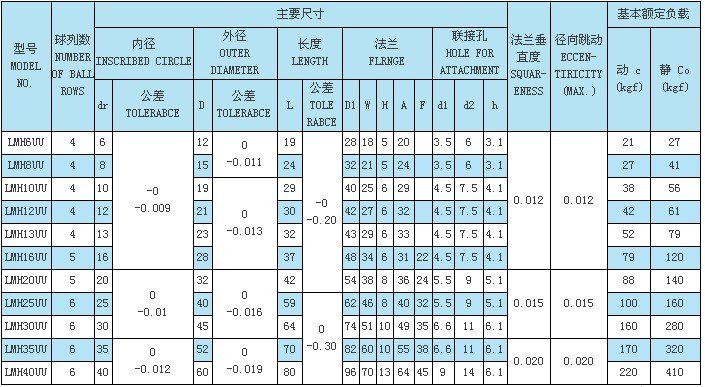
Specification
Linear bearing often used with quenching line transmission shaft, a systerm for rectilinear movement. It has lower loading capacity due to the point contact between the load-carrying balls and quenching transmission shaft, and characterized by smallest friction, high precision and fast moving speed in case of rectilinear movement.
Linear bearing is a linear motion system, used for linear stroke and cylindrical shaft. Because the bearing ball is in contact with the bearing jacket point, the steel ball rolls with the minimum friction resistance, so the linear bearing has small friction and is relatively stable. It does not change with the bearing speed, and can obtain the smooth linear motion with high sensitivity and high precision.
Related Products

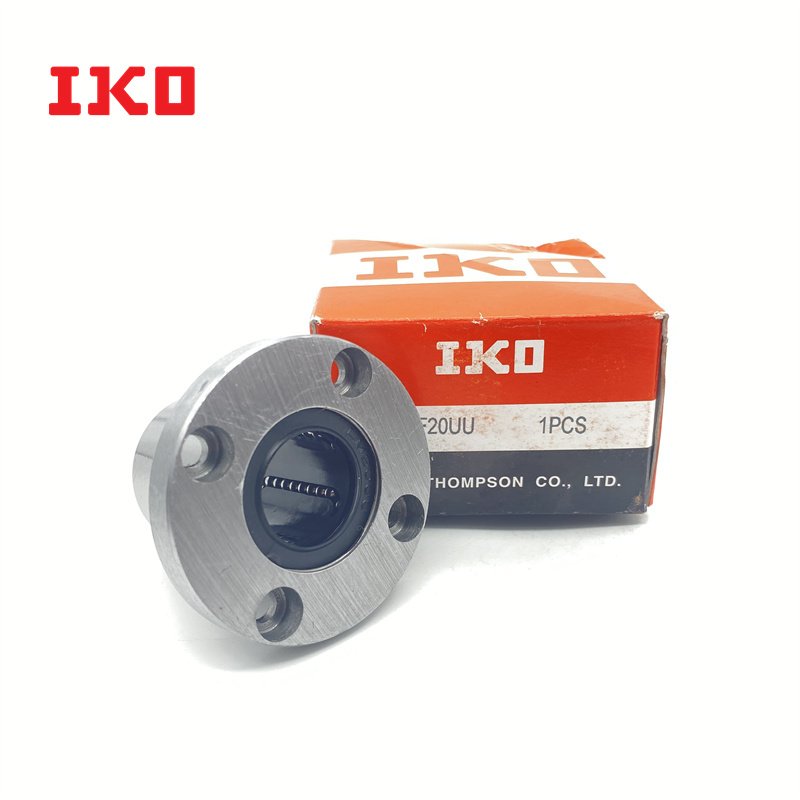

Type of bearing
"LM" metric standard type linear bearing
"LME" inch standard type linear bearing
"UU" rubber seals on the both sides of the long type linear bearing
"OP" open type linear bearing
"AJ" adjustment type linear bearing
*LM...UU: LM...(sylinder), LM...OP(open type), LM...AJ(clearance adustable)
*LME...UU: LME...(sylinder), LME...OP(open type), LME...AJ(clearance adustable), LM...UU & LME...UU: Long type
*KH: High-precision mini bearing


FAQ
1How to install linear bearings?
1. Before installing linear bearings, the raw edges, dirt and surface scars of the mechanical mounting surface must be removed. Linear bearings are coated with antirust oil. Please clean the datum surface with cleaning oil before installation. Usually, the datum surface is easy to rust after removing the antirust oil.
2. the linear bearing will be gently placed on the bed, the use of lateral fixing screws or other fixing fixture to make the line rail and the side mounting surface gently fit. Before installation and use, it is necessary to confirm whether the screw holes are consistent. Assuming that the machining holes of the base are not consistent and the bolts are forcibly locked, the combination accuracy and use quality will be greatly affected.
3. Tighten the positioning screw of the linear bearing in order from the center to both sides, so that the track is fitted with the vertical mounting surface, and stable accuracy can be obtained from the central position to both ends. After the vertical datum is tightened slightly, the locking force of the lateral datum is strengthened, so that the linear bearing can practically fit the lateral datum.
4. Use the torque wrench to lock the torque one by one according to various materials, and slowly tighten the positioning screw of the linear bearing slide rail.
5. Use the same installation method to install the auxiliary rail, and install the slide seat to the main rail and auxiliary rail individually. Note that after installing the linear slide on the slide seat, many accessories cannot be installed due to the limited installation space. The required accessories must be installed together at this stage.
6. Gently place the moving platform onto the sliding seat of the linear bearing main rail and auxiliary rail, and then lock the lateral pressing screw on the moving platform, which can be completed after installation and positioning.
2What are the precautions for linear bearing installation?
Installation precautions:
1. When the linear bearing is assembled in the bearing seat, do not directly collide with the side end of the bearing housing and the clamping ring and sealing ring. Please use special tools to press it evenly and slowly.
2. When assembling linear bearings and special shafts, attention should be paid to keeping the shaft and bearing shaft parallel, and too large an Angle should not be used for installation. Too large an Angle is easy to affect the accuracy and service life of bearings, and may even directly cause the steel ball to fall off.
Notes for use:
Linear bearings are designed to be used in linear repeated motion, not suitable for rotary motion, which will affect the life of linear bearings.
3If the linear bearing meets the fault, how to solve it?
The fault phenomenon of linear bearings is generally manifested in two kinds, one is that the temperature of the bearing safety part is too high, the other is that there is noise in the bearing operation.
1. The bearing temperature is too high
When the mechanism is running, the installation part of the bearing is allowed to have a certain temperature. When you touch the shell of the mechanism with your hand, it should be normal to not feel hot, otherwise it indicates that the temperature of the bearing is too high. The reasons for the high temperature of the bearing are: the quality of the lubricating oil does not meet the requirements or deterioration, the viscosity of the lubricating oil is too high; The mechanism assembly is too tight (insufficient clearance); Bearing assembly is too tight; The bearing seat ring rotates on the shaft or in the shell; Excessive load; Bearing cage or linear body fracture, etc.
2. Bearing noise
The linear bearing is allowed to have a slight running sound in the work. If the sound is too large or there is abnormal noise or crash, it indicates that the bearing is faulty. The reasons for the noise of linear bearings are more complex. One is the wear of the inner and outer rings of bearings. Due to this wear, the fit relationship between bearings and housing, bearings and shaft is damaged, leading to the axis deviated from the correct position, and abnormal sound is generated when the shaft moves at high speed. When the bearing is tired, the surface metal spalling will also increase the radial clearance of the bearing and produce abnormal sound. In addition, insufficient bearing lubrication, the formation of dry friction, and bearing breakage will produce abnormal sound. After the bearing is worn loose, the cage is loose and damaged, and there will be abnormal sound.