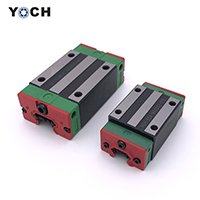
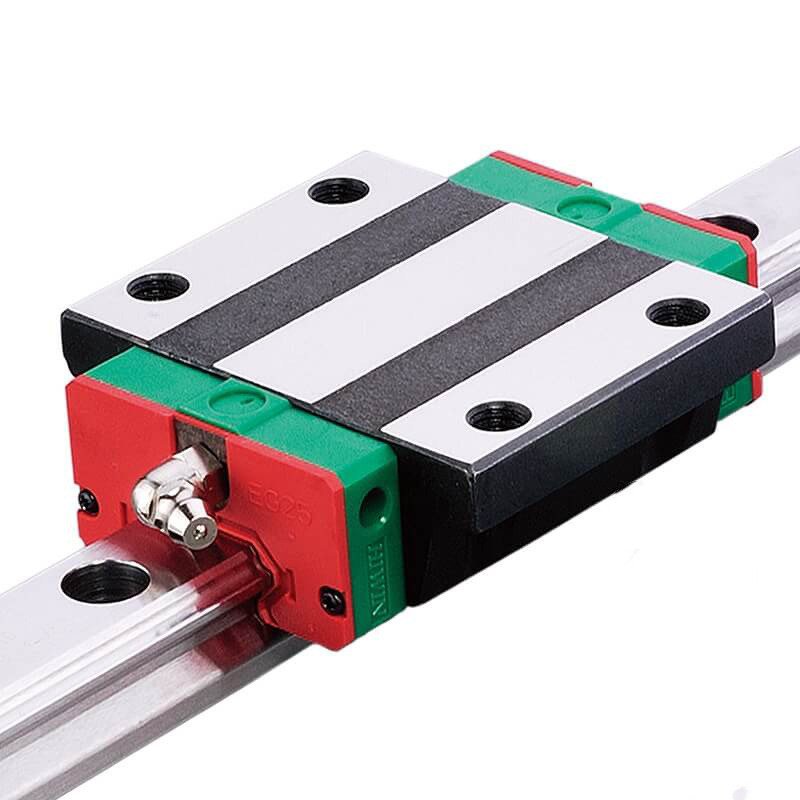
Bearing description:
A groove or ridge of metal or other material that supports, holds, guides, and reduces friction in a moving device or device. A longitudinal groove or ridge on the surface of a guide rail used for guiding, securing machine parts, special equipment, instruments, etc. Guide rail, also known as sliding rail, linear guide rail, linear sliding rail, used for linear reciprocating motion occasions, has a higher load rating than linear bearings, while can bear a certain torque, can achieve high precision linear motion under high load.
The guide rail should meet the basic requirements:
1) Guiding accuracy
Guiding accuracy: straightness of linear motion guide (rectilinear) or roundness of circular motion guide (true roundness).
Factors affecting the accuracy of the mutual position between guide rail and other moving parts:
(1) Geometric accuracy of guide rail
(2) Structural form
(3) the stiffness of the guide rail and its supporting parts
(4) oil film stiffness
(5) thermal deformation, etc
2) Accuracy retention: the key to guide rail design and manufacturing, is also one of the important indicators to measure the quality of machine tools. The main factor affecting the accuracy retention is wear, namely the wear resistance of the guide rail.
Insufficient stiffness affects the relative position accuracy between components and guide accuracy of guide rail, makes the specific pressure distribution on the guide rail uneven, and intensifies the wear of guide rail.
Wear resistance -- whether guiding accuracy can be maintained for a long time. The wear resistance of the guide rail is related to the material of the guide rail, the friction property of the guide rail surface, the force of the guide rail and the relative motion speed of the two guides.
3) Stability of low speed movement: to ensure that there is no instability in low speed movement or trace displacement.
Influence: increase the roughness of the machined surface; The positioning accuracy will be reduced if the positioning motion is not smooth.
Influencing factors: structure and lubrication of guide rail; The difference of dynamic and static friction coefficient drives the stiffness of the transmission system of the moving guide rail.
4) Structural manufacturability
Where possible, the structure of the guide should be as simple as possible to facilitate manufacturing and maintenance.
For scraping guide rail, the amount of scraping should be reduced as far as possible. For the mounted guide rail, it should be easy to replace.
Protection of guide rail:
The protection of guide rail can prevent or reduce the wear of guide pair and prolong the life of guide rail. Protective devices are produced by special manufacturers and can be purchased.
There are many ways to protect the guide rail. The common protective cover is shown in Figure 1. Numerical control machine tools. Especially in the center of cutting, iron filings, coolant a lot, easy to enter the guide rail, increase guide wear; When the iron filings are large, the worktable is raised to affect the accuracy of the guide rail, so the steel plate telescopic protective cover is usually used.
Application:
The sliding guide has the advantages of simple structure, convenient manufacture and high contact stiffness. However, the traditional sliding guide has large friction resistance, fast wear, large difference in dynamic and static friction coefficient, and easy to produce crawling phenomenon at low speed. In order to improve the positioning accuracy and motion stability of CNC machine tools, plastic guide rails have been widely used in CNC machine tools.