- Welcome to YOCH Bearing!
- 0086-531-85866205
- 0086-16653196205
- market@yochibearing.com

Main Structural Parameters of Thrust Roller Bearings
Reducing the Life Calculation of Thrust Roller Bearings
27/10/2025The Importance of Regular Bearing Maintenance
03/11/2025A Comprehensive Guide to the Key Components of Thrust Roller Bearings
Thrust roller bearings are an essential component in various mechanical systems, providing reliable support for axial loads. Understanding their main structural parameters is crucial for engineers and technicians to select the right bearings for specific applications.
1. Basic Components of Thrust Roller Bearings
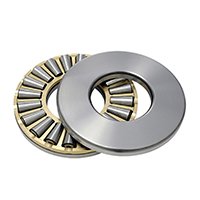
Thrust roller bearings consist of several key components, each designed to work together to provide efficient load support and smooth operation. The primary components include the thrust rollers, the raceways, the cage, and the housing washer.
Thrust Rollers
The thrust rollers are the rolling elements that bear the axial load. They are typically cylindrical in shape and are designed to roll smoothly between the raceways. The size and number of rollers can vary depending on the load capacity and speed requirements of the application. For example, in high-load applications, larger and more rollers may be used to distribute the load more evenly and reduce the stress on individual rollers.
Raceways
The raceways are the surfaces on which the thrust rollers roll. They are usually located on the housing washer and the shaft washer. The design of the raceways is critical for ensuring smooth rolling motion and minimizing friction. The raceways must be precisely machined to ensure a close fit with the rollers, which helps to reduce wear and increase the bearing’s service life.
Cage
The cage is an important component that separates the thrust rollers and maintains their correct position. It prevents the rollers from rubbing against each other, which can cause excessive wear and generate heat. The cage can be made from various materials, including steel, brass, or plastic, depending on the operating conditions and performance requirements. For instance, in high-temperature applications, a steel cage may be preferred due to its superior heat resistance.
Housing Washer
The housing washer is the stationary part of the thrust roller bearing that is mounted on the housing. It provides a stable surface for the raceway and supports the thrust rollers. The housing washer must be strong enough to withstand the axial load and must be accurately machined to ensure proper alignment with the shaft washer.
2. Key Structural Parameters
Several structural parameters are critical in determining the performance and suitability of thrust roller bearings for different applications.
Load Capacity
The load capacity of a thrust roller bearing is a key parameter that indicates the maximum axial load it can support. This is influenced by the size and number of thrust rollers, as well as the design of the raceways. Bearings with higher load capacities are typically larger and have more rollers. Engineers must select bearings with a load capacity that matches or exceeds the expected load in their application to ensure reliable operation.
Speed Rating
The speed rating of a thrust roller bearing refers to the maximum rotational speed at which it can operate without compromising its performance. This is affected by factors such as the size and shape of the rollers, the cage design, and the lubrication conditions. Bearings designed for high-speed applications often have optimized roller shapes and cage materials to reduce friction and heat generation.
Precision and Tolerance
The precision and tolerance of the bearing components are crucial for ensuring smooth operation and long service life. High-precision bearings have tighter tolerances, which means that the dimensions of the rollers, raceways, and other components are more closely controlled. This reduces the likelihood of misalignment and wear, making the bearing more reliable and efficient.
Lubrication and Sealing
Proper lubrication and sealing are essential for the performance and longevity of thrust roller bearings. Lubrication reduces friction and wear between the rollers and raceways, while sealing prevents contaminants from entering the bearing and causing damage. Bearings may be designed with different types of seals, such as contact seals or non-contact seals, depending on the environmental conditions and performance requirements.
3. Selection and Application
Selecting the right thrust roller bearing for a specific application involves considering the main structural parameters and matching them to the operating conditions. Engineers must evaluate factors such as load capacity, speed rating, precision, and environmental conditions to choose a bearing that will provide reliable and efficient performance.
For example, in a high-load, low-speed application such as a large industrial fan, a thrust roller bearing with a high load capacity and robust construction may be required. In contrast, for a high-speed application such as a precision machine tool, a bearing with a high speed rating and optimized design for minimal friction would be more appropriate.
Conclusion
Thrust roller bearings play a vital role in many mechanical systems, providing reliable support for axial loads. By understanding the main structural parameters, including the basic components, key parameters such as load capacity and speed rating, and the importance of precision and lubrication, engineers can make informed decisions when selecting bearings for their applications. Proper selection and maintenance of thrust roller bearings can significantly enhance the performance and longevity of mechanical systems.