- Welcome to YOCH Bearing!
- 0086-531-85866205
- 0086-16653196205
- market@yochibearing.com

High-Temperature Bearings: Complete Specification Guide for 450°C+ Industrial Applications
Roller Bearings in Railway Transportation: The Unsung Heroes Keeping Trains on Track
17/11/2025Understanding and Optimizing Tapered Roller Bearing Preload for Maximum Performance
26/11/2025High-Temperature Bearings Overview – Why Specification Matters
When equipment operates above 300 °C, standard steel races and polymer cages fail within hours. A correctly specified high-temperature bearing keeps kilns, ovens, and turbomachinery running for years. This guide translates the latest DIN 623-1 and ASTM standards into practical selection criteria, so you can match every specification detail to your real-world thermal load, speed, and contamination profile.
What Are High-Temperature Bearings? Definition & Core Specifications
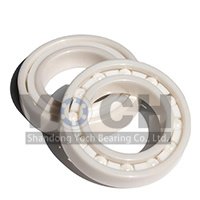
High-temperature bearings are rolling-element bearings engineered to sustain reliable operation at continuous temperatures beyond 200 °C and peak excursions above 450 °C without measurable loss of hardness, dimensional stability, or lubricating film. Key specification benchmarks include:
- Material heat-treat stability: ≥ 58 HRC at 350 °C
- Radial clearance groups: C4H, C5H (DIN 620-4)
- Cage temperature index: PI ≥ 250 °C for PEEK, ≥ 300 °C for AISI 304 or bronze
- Lubricant evaporation loss: < 5 % after 100 h at 280 °C per ASTM D972
High-Temperature Bearing Temperature Ranges & Material Specifications
| Continuous °C | Peak °C | Ring Steel | Ball/Cage | Lubricant |
|---|---|---|---|---|
| 250 | 300 | 100Cr6 HTF | Si₃N₄ hybrid | PFPE grease |
| 350 | 400 | X65Cr13 (SS) | SS 316L | Graphite paste |
| 450 | 500 | NiCr20TiAl (Inconel-based) | Full Si₃N₄ | Solid MoS₂ coating |
Specify stabilisation suffixes S1–S4 per ISO 492 to control residual austenite < 3 %, preventing growth at 400 °C.
Load & Speed Ratings – How to Specify High-Temperature Bearings Correctly
Dynamic load rating (C) drops 5 % for every 50 °C above 150 °C. Adjust catalog C by factor fT = 0.95^((T−150)/50).
Speed limit nθ is governed by cage material and lubricant flash point:
nθ = n25 · (kθ / k25) where kθ = (460 − T)/(460 − 25) (Arrhenius factor).
For graphite-lubricated full-complement cylindrical rollers at 350 °C, reduce DN value to 50 000 mm·rpm vs. 300 000 at room temperature.
High-Temperature Bearing Lubrication Specifications – Grease, Paste, Solid Film
- PFPE grease: Base oil viscosity 420 cSt at 40 °C, evaporation < 1 % @ 299 °C (ASTM D2595). Specify NLGI 2, additive package with 5 % Al-Naphthenate for anti-corrosion.
- Graphite paste: Ash content < 0.1 %, particle size D90 5 µm; apply 2 g per 6210-size bearing.
- MoS₂ solid film: Thickness 3–5 µm, burnished, friction coefficient ≤ 0.08 at 450 °C in vacuum.
Dimensional & Tolerance Standards for High-Temperature Bearings
Order bearings with C4H or C5H clearance to absorb radial expansion. Tolerances follow ISO 492 P6 or P5, but specify “HT” suffix for heat-stabilised rings. Shaft seat recommendation: k5/j5 for 300 °C, transitioning to f6 above 400 °C to allow differential expansion.
Sealing & Shielding Options in High-Temperature Bearing Specifications
- Labyrinth shields (ZZH): 0.3 mm air gap, 302 SS, withstand 500 °C without creep.
- Graphite-impregnated glass-fiber seals (TSH): Reduce contamination ingress by 85 % compared with open types, max 350 °C.
- Integral ceramic spray coating on OD: Creates 25 µm secondary seal surface, specified as suffix “CS”.
Industry-Specific Specification Examples – Furnace, Glass, and Food-Grade High-Temperature Bearings
- Furnace fan: 6312-2ZHTC4S3, 120 °C→400 °C cycle, PFPE grease, 17 000 h L10.
- Glass tempering rolls: NU220ECMS1, full Si₃N₄ rollers, MoS₂-coated, 460 °C, 0.15 m/s.
- Food dryer: Stainless 6203-2RSTH, FDA-compliant graphite paste, wash-down safe, metal-detectable cage.
Common Specification Mistakes When Selecting High-Temperature Bearings
- Ignoring stabilisation suffix—rings grow 0.15 % at 350 °C without S3.
- Using ordinary C3 clearance; switch to C4H minimum.
- Overlooking cage quality—PEEK above 250 °C softens, causing seizure.
- Applying standard lithium grease—drops to liquid at 180 °C, leading to sudden failure.
FAQ – Quick Answers on High-Temperature Bearing Specifications
Q: Can I relubricate a 450 °C bearing?
A: Only if you specify a relubrication groove (suffix “G”) and use solid MoS₂ powder; PFPE greases oxidise above 320 °C.
Q: What is the maximum rpm at 400 °C?
A: For a 6210 hybrid ceramic, DN = 40 000 → 2 000 rpm. Specify silicon-nitride balls to raise limit 25 %.
Q: Do high-temperature bearings cost more?
A: Expect 3–4× standard price due to heat-stabilised steel, Si₃N₄ elements, and special lubricants; ROI arrives through 5× longer service life.
Conclusion – Specify High-Temperature Bearings with Confidence
Match temperature class, clearance, cage, and lubricant to your operating envelope, and you will cut unplanned downtime by > 60 %. Use this specification guide as a checklist, quote the exact suffixes when ordering, and your next high-temperature bearing will deliver the reliability your process demands.