- Welcome to YOCH Bearing!
- 0086-531-85866205
- 0086-16653196205
- market@yochibearing.com

What Are Cylindrical Roller Bearing

What Are Spherical Roller Bearings
26/11/2021
What Are Our Concerns About Bearings(1)
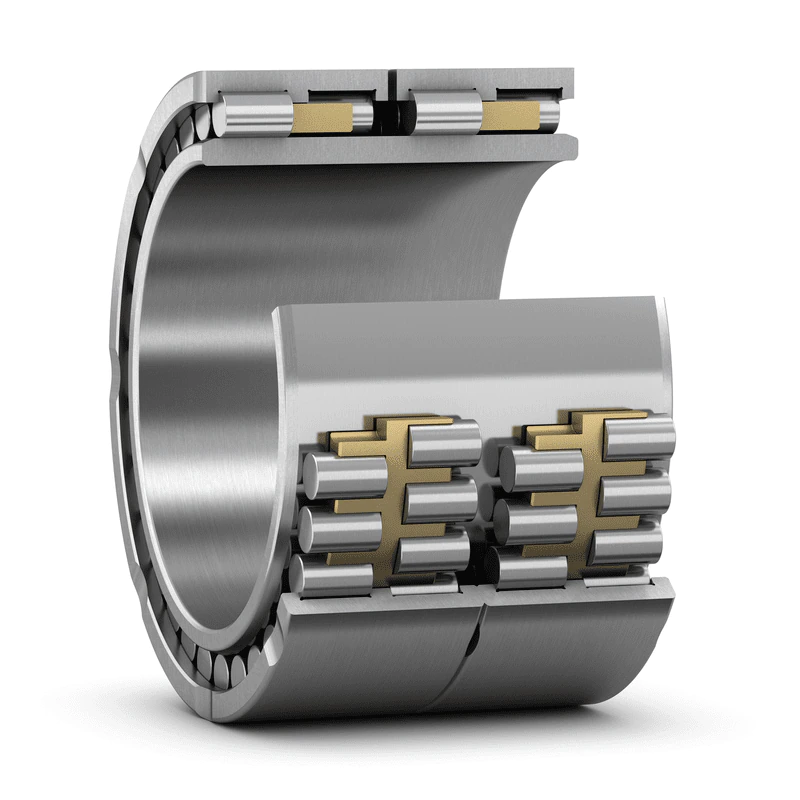
30/11/2021Rolling element bearings are perhaps the most common form of bearing and operate by carrying a load by placing rolling elements, such as balls or rollers, in between two rings, known as races. A common type of rolling bearing is the cylindrical roller bearing, which, as their name implies, uses cylinders to reduce friction between moving parts.
There are many types and sizes of cylindrical roller bearings including tapered, needle and spherical. Most of these are single row bearings with a cage. The cage prevents the rolling elements from colliding into one another, which helps reduce friction, wear and prevents bind.

Unlike their spherical counterparts, cylindrical roller bearing’s larger surface area allows them to carry larger loads, but this means increased friction and lower operating speeds. As with other roller bearings, cylindrical roller bearings must always be subjected to a minimum load. This is particularly true if the bearings are to encounter higher speeds, high acceleration forces or rapid changes in load direction. Without proper load, inertial forces can cause the rollers to slide, rather than roll, along their races, causing damage.
Cylindrical roller bearings are commonly used in belt or gear-driven medium to large sized electric motors. The earliest known cylindrical bearings could have been the logs used by ancient civilizations to move large stone structures around.
Cylindrical roller bearings have high radial-load capacity and moderate thrust loads. They contain rollers which are cylindrically-shaped, but are not true cylinders. Instead, these rollers are crowned or end-relieved to reduce stress concentrations. This geometry results in low friction and allows for high-speed applications. Cylindrical roller bearings are commonly available in precision grades such as RBEC-5, a classification from the Roller Bearing Engineers Committee (RBEC). RBEC ratings describe the accuracy and tolerance range for different types of bearings. As a rule, the higher the RBEC number, the tighter the bearing tolerances. Typically, cylindrical roller bearings are lubricated with oil, which also serves as a coolant.
Materials Used
Most cylindrical roller bearings are made of alloy steels or low-carbon steels. Some applications require the use of case-hardened or thorough-hardened, high-carbon, bearing-quality steel. High-carbon grades of steel do not require
carburizing and can be case-hardened by induction heating or thorough-hardened by conventional heating methods. When low-carbon, carburized grades of steel are used, carbon is introduced after the cylindrical roller bearings are machined to a depth sufficient to produce a hardened case that can sustain bearing loads. The addition of carbon and alloys ensures the proper combination of a hard, fatigue-resistant case and a tough, ductile core.
Specifications
Bore size and outside diameter (OD) are important specifications to consider when selecting cylindrical roller bearings. The bearing industry uses a standard, numbered system for roller bearings with metric-diameter bores. For bore sizes 04 and up, multiply the bore size by 5 to identify the bore diameter in millimeters (mm). The outside diameter of cylindrical roller bearings includes the housing (if any), but excludes the flange.
Other important specifications for cylindrical roller bearings include overall width, rated speed (oil), static axial load, static radial load, dynamic axial load, and dynamic radial load. Static axial load and static radial load are, respectively, the maximum axial and radial loads that bearings can withstand without permanent deformation. Dynamic axial load and dynamic radial load are, respectively, the calculated axial and radial loads under which a group of identical bearings with stationary outer rings can endure for a rating life of 1 million revolutions of the inner ring.
Applications
There are many applications for cylindrical roller bearings. Examples include mining, petroleum production, power generation, power transmission, cement processing, aggregate crushing, and metal recycling. Some cylindrical roller bearings are used in briquetting machines, rubber mixing equipment, rolling mills, rotary dryers, or pulp and paper machinery. Others are used in construction equipment, crushers, electric motors, blowers and fans, gears and drives, plastics machinery, machine tools and traction motors and pumps.