- Welcome to YOCH Bearing!
- 0086-531-85866205
- 0086-16653196205
- market@yochibearing.com

What Are Our Concerns About Bearings(3)

What Are Our Concerns About Bearings(2)
01/12/2021
What Are Our Concerns About Bearings(4)
02/12/2021Q1:What does it mean to have “LM” in the specifications of bearings? Do you mean material, or something else?
A:Linear bearing “LM” refers to the Asian series standard. LME is a European series and Sw is an English series.
Q2:Normal bearing classification methods and bearing specifications and models?
Two kinds of imported rolling bearings are introduced
1. Classification according to rolling bearing structure type
(1) According to the load direction or nominal contact Angle that bearings can withstand, they are divided into:
1) Radial bearing —- is mainly used for rolling bearings bearing radial loads, and its nominal contact Angle is from 0 to 45. According to different nominal contact angles, it can be divided into: radial contact bearings —- radial contact bearings with nominal contact angles of 0: radial contact bearings —- radial contact bearings with nominal contact angles of greater than 0 to 45.
2) Thrust bearings —- are mainly used for rolling bearings bearing axial loads with nominal contact angles greater than 45 to 90. According to different nominal contact angles, it can be divided into: axial contact bearings —- thrust bearings with nominal contact angles of 90: thrust angular contact bearings —- thrust bearings with nominal contact angles of more than 45 but less than 90.
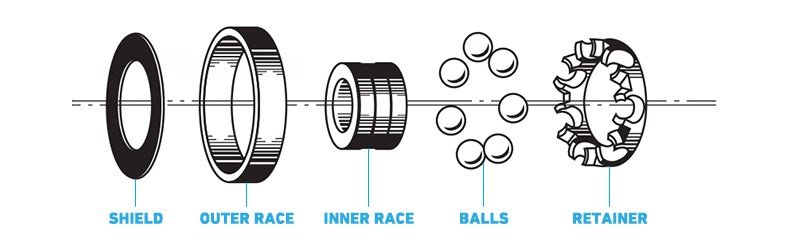
(2) According to the type of its rolling body, bearings are divided into:
1) Ball bearing —- rolling body is a ball:
2) Roller bearing —- The rolling body is roller. Roller bearing according to the type of roller, and divided into: cylindrical roller bearing —- rolling body is cylindrical roller bearing, cylindrical roller length and diameter ratio is less than or equal to 3; Needle roller bearing —- the roller is a needle roller bearing, the ratio of needle length to diameter is greater than 3, but the diameter is less than or equal to 5mm; Tapered roller bearing —- the rolling body is a tapered roller bearing; Self-aligning roller bearings – rolling bodies are spherical roller bearings.
(3) According to whether the bearing can be self-aligning when working, it can be divided into:
1) Self-aligning bearing —- raceway is spherical and can adapt to angular deviation and angular motion between two raceway axis lines;
2) non-aligning bearings (rigid bearings)—- bearings with offset axis line Angle between raceways.
(4) According to the number of columns of the rolling body, bearings are divided into:
1) single row bearings —- bearing with a row of rolling bodies;
2) double row bearings —- bearing with two rows of rolling bodies;
3) Multi-row bearings —- bearings with more than two rows of rolling bodies, such as three-row and four-row bearings.
(5) According to whether its components can be separated, bearings are divided into:
1) separable bearings —- bearing with separable parts;
2) non-detachable bearing —- bearing in the final matching, the ring can not be arbitrarily free separation of bearings.
(6) Bearing can also be divided into various structural types according to its structural shape (such as whether there is a filling groove, whether there is an inner ring, an outer ring and the shape of the ring, the structure of the retaining edge, and even whether there is a cage, etc.).
2. Classification according to the size of rolling bearing
According to the size of its outer diameter, bearings are divided into:
(1) miniature bearings —- nominal outer diameter size range of bearings below 26mm;
(2) small bearing —- nominal outer diameter size range of 28-55mm bearing;
(3) small and medium-sized bearings —- nominal outer diameter size range of 60-115mm bearings;
(4) medium and large bearings —- bearing with nominal outer diameter size range of 120-190mm
(5) large bearing —- nominal outer diameter size range of 200-430mm bearing;
(6) Super large bearing —- nominal outer diameter size range of 440-2000mm bearing.
(7) Heavy large bearings —- bearing with nominal outer diameter size range of more than 2000mm.
Q3:What is the meaning of LME8UU letter of linear bearing?
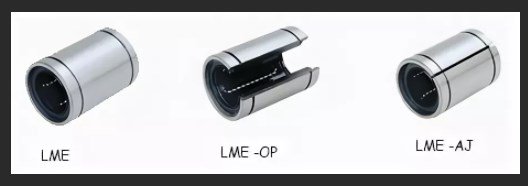
A:LM: Linear bearing specifications
E: European standard
8: OUTER diameter of LM axis
UU: Sealed at both ends
Q4:Why are there no linear bearings with diameter 18?
A:Linear bearings have their own standards, users can only apply the existing standards. Unless you contact the manufacturer, specially for you to make a special specification of linear bearings. But the cost would be much higher.
Q5: Triangle flange bearing inner diameter 30mm?
A:LMH30LUU inner hole 30MM oval flange lengthened linear bearing trimming lengthened linear bearing
Q6:Whether bearing 3113184 is a cone bearing or not?
A:Inner diameter 420 (mm) Outer diameter 620 (mm)
Thickness 150 (mm) Weight 157 (kg)
Construction machinery cage and its material brass
Volume Specifications Large 200≤D≤430 Roller type cylindrical roller
Number of rolling columns Double row Raceway Type Straight raceway
Use characteristics other load direction centripetal
Type self-aligning roller bearings
Q7:What does the bearing type mean?
A:I. Bearing model — basic model
– A number or a letter or combination of letters indicates the bearing type.
— The last two digits determine the ISO size series; One digit represents the width or height series (dimensions B, T, or H, respectively) and the second digit represents the diameter series (dimensions D).
— The last two digits of the basic model are the size code of the bearing; Multiply by 5 to find the inside diameter in millimeters. But there are exceptions to any rule. Important exceptions to the bearing type system are listed below.
1. In some cases, a number indicating the bearing type and/or a number indicating the size series is omitted. These figures are enclosed in brackets in the table.
2. For bearings with an inner diameter less than or equal to 10 mm or greater than or equal to 500 mm, the inner diameter is usually expressed in millimeters, without code. Dimensions are separated from the rest of the bearing type by a diagonal line, for example: 618/8 (d = 8 mm) or 511/530 (d = 530 mm). In accordance with ISO 15:1998
The method also applies to standard bearings with diameters of 22, 28 or 32 mm, such as 62/22 (d = 22 mm).
3. Bearings with inner diameters of 10, 12, 15 and 17 mm have the following size code marks: 00 = 10 mm 01 = 12 mm 02 = 15 mm 03 = 17 mm
4. For some smaller bearings with an inner diameter less than 10 mm, such as deep groove, self-alighting and angular contact ball bearings, the inner diameter is also indicated by millimeters (no code name), but it is not separated from the series by diagonal lines, such as 629 or 129 (d = 9 mm).
5. The bearing inner diameter that deviates from the standard inner diameter is always not coded, but represented by as many as three decimal millimeters. The id mark is part of the base model and is separated from the base model by a diagonal line, e.g. 6202/15875 (d = 15875 mm =5/8 in.).
Two, series models
Each standard bearing belongs to a specific bearing series and is determined by a basic model with no meaning of size. Series models often include A suffix A, B, C, D, or E or A combination of these letters, such as CA. These letters are used to identify internal design differences, such as contact angles.
The commonly used series models are shown in the table above the bearing diagram. Numbers in brackets are not included in series models. SKF bearing prefix code (prefix) and its meaning
GS — Thrust cylindrical roller, thrust needle roller bearing ring. Example: GS81107- seat ring of thrust cylindrical roller bearing 81107. K — thrust roller and cage assembly. Example: K81170.
K- – Inch tapered roller bearings with inner ring (inner cone) or outer ring (cone ring) with roller and cage assembly in accordance with AFBMA standard series. Example: K-09067 — inner cone of tapered roller bearing series 09000.
L — Single inner or outer ring of separated bearing. Example: INNER ring of cylindrical roller bearing NU207. SKF bearing rear code (suffix) and its meaning
Single row angular contact ball bearing ACD — Contact Angle 25 degrees. B — Contact Angle is 40 degrees. CC — Contact Angle is 12 degrees.
Self-aligning roller bearing
CAC, ECAC, CA, ECA — these are designed for large size bearings with symmetrical rollers. Both sides of the inner ring are provided with fixed guard edges, and the inner ring is blocked in the activity. The cage is a solid brass or steel frame. CAC and ECAC bearing roller and raceway surfaces are optimized to facilitate the roller and reduce friction. ECAC type with stiffener roller for increased load capacity.
-2F — External spherical ball bearing with dust rejection rings on both sides. External spherical ball bearing with combined dust rejection rings on both sides.
G — Universal matching single row angular contact ball bearings. When the bearings are arranged face to face or back to back, there is a certain pre-load before installation.
GA — Face to face, back to back arrangement, there is a lighter preload in the bearing. GB — Face to face, back to back arrangement, bearing with medium preload. GC — Face to face, back to back arrangement, there is a heavy preload in the bearing.
K — Conical hole, taper 1:12. K30 — Conical hole, taper 1:30. FAG bearing front code (prefix) and its meaning R is directly placed before the bearing basic code, and the rest of the front code is separated from the basic code with small dots. GS — Thrust cylindrical roller bearing ring. Example: Gs.81112K — Roll… K — Conical hole, taper 1:12. K30 — Conical hole, taper 1:30. FAG bearing prefix code (prefix) and its meaning
R is placed directly before the bearing basic code number, and the other front codes are separated from the basic code by small dots.
Q8:The meaning of several bearing models
A:Bearing steel retainer W33: Bearing outer ring with oil groove for oil retention
Ucp2132: represents a dimensional classification section of bearingsSKF: 7324BCB is not a complete model, angular contact ball bearing E: bearing retainer is steel retainer C: Contact Angle Angle! Complete models are: 7324BECB 7324BECBM
Q9:Bearing Model 22216CA/W33 Meaning?
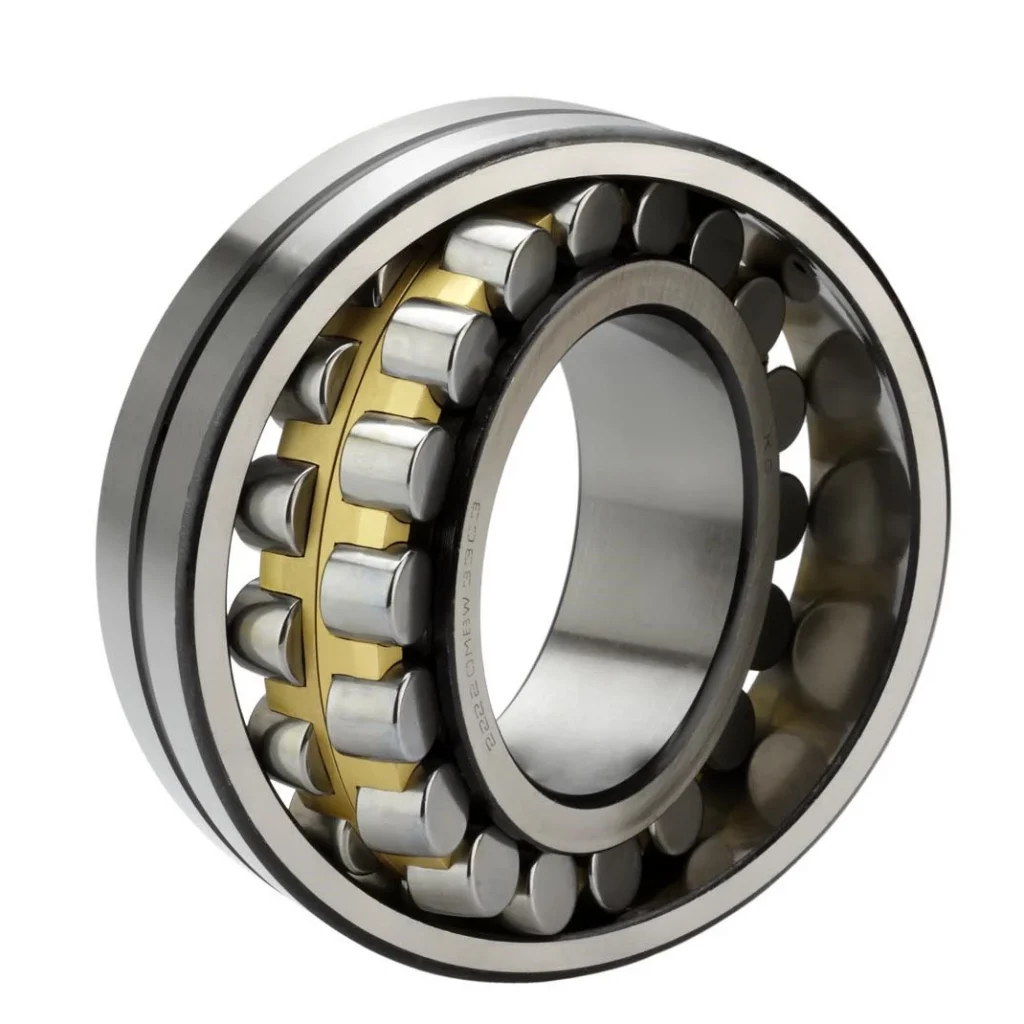
A:Self-aligning roller bearing inner diameter 80mm outer diameter 140mm height 33mm CA is copper cage W33 has no practical significance.
Q10: Explain the meaning of rolling bearing code 6024?
A:Description of model 6024:
This model number should be 6 (1) 024 where the “1” in parentheses is omitted
6 stands for single row deep groove balls
“1” represents the width series
0 stands for diameter series width series and diameter series are collectively called dimension series
24 represents the inner diameter size 24×5=120mm