- Welcome to YOCH Bearing!
- 0086-531-85866205
- 0086-16653196205
- market@yochibearing.com

How to Select the Right Thrust Roller Bearings: A Guide to Key Parameters
Vibration and Noise Reduction in Thrust Roller Bearings: A Comprehensive Approach
08/12/2025SKF Bearing Storage Standards – Comprehensive Guidelines for Maintaining Long-Term Performance
15/12/2025Choosing the correct thrust roller bearing is not a matter of guesswork. It is a disciplined process of matching measurable parameters to real application demands. The checklist below distills decades of field experience into the essential numbers you must verify before a bearing is approved for your design.
- Axial Load Capacity (Ca) Start with the peak axial force the bearing must carry. Convert every dynamic event—start-up shocks, emergency stops, vibration peaks—into a single equivalent axial load (Pa). The required basic dynamic axial load rating (Ca) is then Ca ≥ Pa · fs, where the safety factor fs is 1.2 for smooth-running gearboxes and 1.8 for heavy shock machinery. Do not confuse this with static capacity (Coa); if the machine can sit for hours under full clamp force, Coa must also be checked against the stationary load.
- Speed Ceiling and Thermal Speed Rating Catalogue limiting speeds are valid only for oil mist under 70 °C. Re-rate the bearing for your own lubrication and cooling system. The thermal speed rating (nΘ) is the rpm at which frictional heat equals heat removed; if your application exceeds nΘ, add oil jets or select a cage with lower mass. A polyamide cage may raise nΘ by 15 %, while a machined brass cage trades speed for higher temperature resistance.
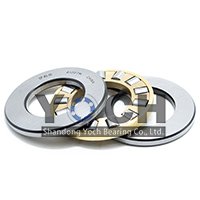
- Contact Geometry: Barrel vs. Cylindrical vs. Tapered Cylindrical rollers give the highest stiffness and lowest friction per dollar, but they tolerate only minute misalignment. Spherical barrel rollers forgive up to 2° of shaft deflection and are unbeatable where housings are split or thermally unstable. Tapered rollers create a true locating centreline and carry combined loads, yet they demand micron-level height matching between adjacent bearings. Ask yourself: “Is misalignment inevitable or merely possible?” The honest answer decides the geometry.
- Oil Film Parameter (Λ) Film thickness divided by composite surface roughness (Λ) predicts micro-pitting life. Compute Λ = (hmin/σ). If Λ < 1, metal touches every revolution and life collapses. Raise Λ above 3 by switching to a higher viscosity grade or by super-finishing raceways to 0.05 µm Ra. Remember that viscosity drops exponentially with temperature; repeat the calculation at the maximum steady-state oil temperature, not at room temperature.
- Coefficient of Friction and Energy Loss A single 292E series spherical thrust bearing running at 500 rpm under 200 kN loses roughly 1.8 kW. If your gearbox contains four such bearings, 7 kW disappears before gears are even considered. Convert losses into annual cost (kWh · €/kWh) and compare it with the price premium of a lower-friction cage or an optimized oil cooler. Energy math often justifies a bearing that appears “over-specified” on paper.
- Mounting Space and Height Tolerance Spherical rollers need a minimum shaft shoulder height of 0.003 · dm (dm = mean bearing diameter). Cylindrical types require a precision ground spacer only a few microns wider than the shaft washer. Measure the actual shoulder run-out with a dial indicator; a 5 µm error can preload the bearing to twice its intended value, chopping calculated life by 70 %. If space is tight, consider the reduced-height 294E series, but check that the lower roller count still meets the Ca demand.
- Environmental Overlay List every non-load variable—salt spray, wash-down chemicals, radiant heat from nearby furnaces, stray electric current. For wet food machinery, specify sealed 293 series bearings with fluorocarbon seals and FDA-approved grease. For current leakage across crane wheels, choose an insulated PEEK-coated washer to prevent fluting. Overlay each environmental factor on the load/speed curve; where the curves intersect, you have the correct cage, seal and coating combination.
- Life Verification Loop After the bearing is tentatively selected, re-enter all refined data—actual load spectrum, measured temperatures, verified viscosity—into ISO 281 and compute the adjusted rating life (Lnm). If Lnm < target life, iterate: larger bore, different cage, better oil, or even a different bearing type. Stop iterating when Lnm exceeds the target by 15 %; this buffer absorbs the scatter of real manufacturing and installation.
Final Note Catalogues show what a bearing can do under ideal conditions. Your machine is not ideal. Translate every real-world imperfection—misalignment, contamination, temperature swing—into a numeric correction factor. When the last correction factor is applied and the bearing still meets life, speed and energy targets, selection is complete. Anything less is a gamble with downtime.