- Welcome to YOCH Bearing!
- 0086-531-85866205
- 0086-16653196205
- market@yochibearing.com

Tapered Roller Bearing Selection Criteria and Load Adaptation Techniques

How to Read a Bearing Number
03/06/2026Needle Bearing Structural Advantages and Key Points for Use in Confined Spaces
11/06/2026Tapered roller bearings are essential components in heavy-duty machinery, automotive transmissions, and industrial gearboxes. Their unique ability to handle combined radial and axial loads makes them indispensable in applications requiring high stiffness and precise shaft positioning. Selecting the right tapered roller bearing requires a thorough understanding of load conditions, geometric tolerances, and operational environment. This article outlines the critical selection criteria and practical techniques for matching bearing capacity to actual working loads.
Understanding Tapered Roller Bearing Structure and Function
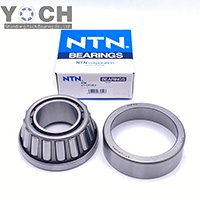
A tapered roller bearing consists of an inner ring (cone), outer ring (cup), tapered rolling elements, and a cage that maintains roller spacing. The raceway angles are designed so that the extended lines of all contact points converge at a single point on the bearing axis, enabling true rolling motion. This geometric configuration allows the bearing to support significant radial loads while simultaneously accommodating axial forces in one direction. The contact angle varies between different series, directly influencing the bearing’s axial load-carrying capacity relative to its radial capacity.
Key Bearing Selection Criteria for Industrial Applications
When selecting a tapered roller bearing, engineers must evaluate several critical parameters. First, determine the magnitude and direction of applied loads, including static loads during startup and dynamic loads during continuous operation. Second, assess the required rotational speed and verify it against the bearing’s limiting speed rating. Third, consider the operating temperature range, as thermal expansion affects internal clearance and preload settings. Fourth, evaluate the required service life based on application criticality—typically calculated using L10 life expectancy formulas. Finally, examine the mounting space constraints and shaft housing designs to ensure proper fit and alignment.
Radial and Axial Load Capacity Analysis for Tapered Roller Bearings
The load adaptation process begins with calculating the equivalent dynamic load (P) using the formula P = XFr + YFa, where Fr represents radial load, Fa represents axial load, and X and Y are coefficients specific to the bearing geometry. For pure radial loads, single-row tapered roller bearings excel in rigid applications such as gearboxes and wheel hubs. When bidirectional axial loads exist, paired mounting configurations—either face-to-face (DF) or back-to-back (DB)—become necessary. In heavy-duty scenarios like rolling mills or mining equipment, multi-row tapered roller bearings distribute extreme loads across multiple roller sets, significantly increasing load-bearing capacity while maintaining compact envelope dimensions.
Bearing Material and Precision Grade Considerations
Material selection profoundly impacts bearing performance under varying loads. Standard chrome steel (AISI 52100) provides excellent hardness and fatigue resistance for general applications. For elevated temperatures exceeding 150°C, bearings manufactured from M50 tool steel or ceramics offer superior dimensional stability. Case-hardened steels withstand high impact loads and surface stresses common in construction machinery. Precision grades range from ABEC-1 (normal) to ABEC-7 (high precision), with tighter tolerances required for machine tool spindles and instrumentation where minimal runout is critical. The surface finish of raceways and rollers also affects lubricant film formation and friction characteristics under load.
Mounting and Clearance Adjustment of the Bearing Assembly
Proper mounting directly determines how effectively a tapered roller bearing adapts to its intended loads. The inner ring typically requires an interference fit on the shaft to prevent creep and fretting corrosion. During installation, apply force exclusively to the ring being mounted—never transmit mounting pressure through the rolling elements. After assembly, internal clearance must be adjusted through axial positioning of the cone relative to the cup. Preload applications, such as machine tool spindles, require negative clearance to eliminate deflection under cutting forces. Conversely, general industrial machinery benefits from slight positive clearance to accommodate thermal expansion and prevent seizure during temperature excursions.
Lubrication Strategies for Optimal Bearing Performance
Lubrication serves as the critical interface between load-bearing surfaces, reducing friction and dissipating heat. For moderate speeds and loads, mineral oil-based greases with lithium or calcium thickeners provide adequate protection. High-speed applications demand low-viscosity synthetic oils that minimize churning losses. Under heavy loads, extreme pressure (EP) additives prevent metal-to-metal contact and pitting. The lubrication method—whether bath, splash, circulation, or oil mist—must match the bearing’s dn value (bore diameter in mm × rotational speed in rpm). Regular lubricant analysis helps detect contamination, oxidation, and wear particles before they compromise load-carrying capability.
Common Bearing Failure Modes and Preventive Measures
Misalignment and improper load distribution represent the leading causes of premature tapered roller bearing failure. When loads concentrate on one side of the roller path, localized fatigue spalling occurs, generating metal debris that accelerates wear. Inadequate lubrication causes scoring and adhesive wear on raceway surfaces. Overload conditions produce plastic deformation and brinelling marks. To prevent these failures, maintain shaft alignment within 0.001 radians, implement condition monitoring through vibration analysis and thermography, and establish preventive maintenance schedules based on actual operating hours rather than calendar time.
Conclusion
Successful tapered roller bearing selection demands systematic evaluation of structural requirements, load characteristics, material properties, and environmental factors. By applying proper calculation methods for equivalent loads, selecting appropriate precision grades, ensuring correct mounting procedures, and implementing targeted lubrication strategies, engineers can maximize bearing service life while maintaining operational reliability. Understanding these selection criteria and load adaptation techniques enables optimal performance across diverse industrial applications, from automotive drivetrains to heavy manufacturing equipment.
We are a bearing supplier from China. If you want to learn more about other bearing knowledge, you can watch our YouTube or contact us.