- Welcome to YOCH Bearing!
- 0086-531-85866205
- 0086-16653196205
- market@yochibearing.com

NTN Large Wind-Turbine Bearing Faults in Service: Lessons from the Field
NTN Metallurgical Thrust Roller Bearing Replacement and Inspection Methods
07/01/2026How to Select NTN Bearing Types and Varieties for Optimal Performance
14/01/2026Wind farms are expected to run for twenty-five years, yet the bearings inside multi-megawatt gearboxes and main shafts often demand major intervention after only three to five. Below are the failure signatures most frequently reported by owners of NTN-equipped turbines, the root causes that diagnostics confirm, and the reliability counter-measures now being written into O&M manuals.
Bearing axial cracking triggered by white-etching cracks (WECs)
Axial fractures that originate 0.1–0.3 mm below the raceway are the single biggest reason for premature withdrawal of NTN cylindrical roller bearings in the planet stage. Metallography shows a network of white-etching cracks that branch toward the surface until macro-spalls appear. The trigger is not overload but a microstructural change: manganese-sulphide inclusions act as stress raisers under cyclic shear, while transient torque reversals during normal or emergency stops supply the driving force. Once the cracks link up, the bearing can lose 30 % of its raceway area in less than 200 h. Retro-specification of vacuum-degassed, inclusion-controlled steel and the addition of ceramic rollers have already doubled the average life of replacement NTN planet bearings in 3 MW class turbines.
Bearing micropitting driven by thin-film lubrication
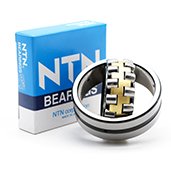
Micropitting—grey staining that later evolves into sharp-edged micro-spalls—is especially common on upwind main-shaft spherical roller bearings when the λ-ratio (film-thickness to composite roughness) falls below 0.8 . In NTN fleets the drop in film thickness is rarely caused by oil degradation; rather, it is the steady rise in bearing temperature that follows rotor misalignment or tower deflection. Once peak contact temperature exceeds 90 °C the synthetic PAO base stock loses 40 % of its viscosity and asperity interaction begins. Field data show that installing a dedicated 5 µm kidney-loop filter and upgrading to a 220 cSt wind-turbine gear oil extends the micropitting initiation period by a factor of three.
Bearing electric-erosion grooving in generator and main shaft
Variable-speed turbines equipped with PWM converters expose every grounded shaft line to 20–60 V of common-mode voltage. When the impedance of the NTN INSOCOAT generator bearing is momentarily exceeded, discharges of 3–8 A create fusion craters that later align into evenly spaced “wash-board” grooves. In the last two years, groove depths >15 µm have been measured in 2.5 MW units after only 8 000 h. The remedy is a hybrid design—ceramic balls plus an aluminium-sprayed outer-ring coating—and the installation of a dedicated shaft-grounding brush. Early adopters have reduced electrical bearing damage to below the 5 µm inspection threshold over a five-year period.
Bearing fretting corrosion during prolonged idling
Modern curtailment strategies leave turbines parked for days with only a 0.1 Hz “creep” to prevent shaft bowing. The slow oscillation is below the threshold needed to renew the raceway oil film, so the load zone sees fretting corrosion that oxidises the steel and reduces the interference fit . NTN SRB main bearings removed after 18-month curtailment trials showed 30 µm of fretting wear and a 30 % drop in drive-up force. Re-greasing with a lithium-complex soap containing 5 % MoS₂ and programming a daily 360° rotation has eliminated measurable fretting in subsequent cohorts.
Bearing spalling from debris bruising
Post-mortem inspection of 52 failed NTN tapered roller bearings from 1.5 MW gearboxes revealed that 70 % of spalls originated at bruises caused by wind-blown dust entering through worn labyrinth seals. Hard particles >12 µm embed in the soft cage material, then roll between raceway and roller, producing Hertzian dents with raised edges that become stress concentrators. Upgrading to triple-lip nitrile seals and adding a desiccant breather reduced particle ingress by 90 % and cut debris-induced spalls from twelve events per 100 turbine-years to two.
Bearing high-temperature seizures linked to under-clearance
Double-row tapered roller bearings that support the planet carrier are installed with a slight preload to maximise stiffness. However, when the surrounding aluminium housing expands more than the steel outer ring (Δα ≈ 6 × 10⁻⁶ K⁻¹), the designed preload can double, pushing the bearing into seizure at 110 °C. NTN’s latest specification adds a 50 µm radial clearance “budget” and switches to a two-piece outer ring that allows differential expansion. Field pilots show peak temperatures stabilised below 85 °C even during summer overload events.
Bearing cage pocket cracking under impact loading
Sudden grid loss or emergency braking can accelerate the high-speed shaft from 1 800 rpm to 2 300 rpm in under one second. The inertia of the rollers hammers the cage pockets, causing fatigue cracks that propagate through the rivet holes of pressed-steel cages. NTN’s current counter-measure is a machined, silver-plated brass cage guided on the outer ring, which absorbs 40 % more impact energy and has eliminated cage failures in 4 MW turbines operating on weak grids.
Bearing ring rotation and shaft damage
Loose fits intended to ease field replacement have allowed the inner ring of some NTN cylindrical roller bearings to creep on the shaft, polishing the seat and reducing interference below the 0.01 mm needed for torque transmission . Once relative motion starts, iron-oxide debris fills the oil grooves and accelerates wear. Laser-cladding the shaft with 420 stainless steel and switching to a heavier P6 interference fit (0.04–0.06 mm) has stopped ring rotation in 100 % of retrofitted turbines.
Bearing maintenance interval optimisation
Oil analysis and vibration data from 1 200 NTN bearings show that the classical “annual regrease” rule is either wasteful or too late. Instead, a condition-based interval triggered when either ultra-sonic readings exceed 12 dB above baseline or iron content reaches 150 ppm aligns re-lubrication with actual need. The new schedule has cut grease consumption by 35 % and reduced secondary damage from over-greasing, while maintaining the same 99.2 % gearbox availability.
Conclusion: an integrated view of bearing reliability
No single failure mode dominates NTN wind-turbine history; rather, a sequence of electrical, tribological and mechanical events interact. A bearing that survives WECs may later succumb to micropitting if oil viscosity is not adjusted for temperature, and even a perfectly ground raceway will spall if debris is allowed in. The most reliable fleets are those that treat the bearing as a system component—steel cleanliness, lubricant chemistry, sealing strategy, electrical design and mounting practice must all meet the same target life. With the counter-measures outlined above, NTN now warrants its large wind-turbine bearings for seven full years, a figure that is rapidly approaching the industry’s twenty-year goal.